Castanopsis cuspidata (Japanese chinquapin; Japanese tsuburajii, 円椎) is a species of Castanopsis native to southern Japan and southern Korea.
| Castanopsis cuspidata |
|---|
 |
Conservation status |
|---|
 Least Concern (IUCN 3.1)[1] Least Concern (IUCN 3.1)[1] |
Scientific classification |
|---|
| Kingdom: | Plantae |
| Clade: | Tracheophytes |
| Clade: | Angiosperms |
| Clade: | Eudicots |
| Clade: | Rosids |
| Order: | Fagales |
| Family: | Fagaceae |
| Genus: | Castanopsis |
| Species: | C. cuspidata |
| Binomial name |
|---|
Castanopsis cuspidata
(Thunb.) Schottky |
| Synonyms |
|---|
Pasania cuspidata (Thunb.) Oerst.
Pasaniopsis cuspidata (Thunb.) Kudô
Quercus cuspidata Thunb. |
It is a medium-sized evergreen tree growing to 20–30 m tall, related to beech and oak. The leaves are 5–9 cm long and 2–4 cm broad, leathery in texture, with an entire or irregularly toothed margin. It grows in woods and ravines, especially near the sea.
The cotyledon of the nut is eaten boiled or roasted.
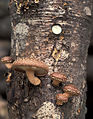
Its dead wood serves as host to many mushroom types, including the shiitake, which literally means Castanopsis mushroom.
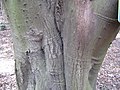
GalleryEditBark of base of mature tree
Tall trunk of mature tree
Slender, fountain-like canopy of mature specimen, viewed from beneath
Mature, deep green leaves
Closeup of slender inflorescences
Preserved specimen from herbarium, with descriptive notes
Dead trunk, with fruiting bodies of shiitake