A grain is a small, hard, dry fruit (caryopsis) – with or without an attached hull layer – harvested for human or animal consumption.[1] A grain crop is a grain-producing plant. The two main types of commercial grain crops are cereals and legumes.
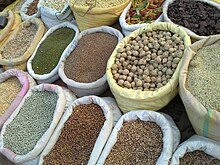
After being harvested, dry grains are more durable than other staple foods, such as starchy fruits (plantains, breadfruit, etc.) and tubers (sweet potatoes, cassava, and more). This durability has made grains well suited to industrial agriculture, since they can be mechanically harvested, transported by rail or ship, stored for long periods in silos, and milled for flour or pressed for oil. Thus, the grain market is a major global commodity market that includes crops such as maize, rice, soybeans, wheat and other grains.
Grains and cereal
Grains and cereal are synonymous with caryopses, the fruits of the grass family. In agronomy and commerce, seeds or fruits from other plant families are called grains if they resemble caryopses. For example, amaranth is sold as "grain amaranth", and amaranth products may be described as "whole grains". The pre-Hispanic civilizations of the Andes had grain-based food systems, but at higher elevations none of the grains was a cereal. All three grains native to the Andes (kaniwa, kiwicha, and quinoa) are broad-leafed plants rather than grasses such as corn, rice, and wheat.[2]
Classification
Cereal grains
A cereal is any grass cultivated for the edible components of its grain (botanically, a type of fruit called a caryopsis), composed of the endosperm, germ, and bran. The term may also refer to the resulting grain itself (specifically "cereal grain"). Cereal grain crops are grown in greater quantities and provide more food energy worldwide than any other type of crop[3] and are therefore staple crops. Edible grains from other plant families, such as buckwheat, quinoa and chia, are referred to as pseudocereals.
In their natural, unprocessed, whole grain form, cereals are a rich source of vitamins, minerals, carbohydrates, fats, oils, and protein. When processed by the removal of the bran and germ the remaining endosperm is mostly carbohydrate. In some developing countries, grain in the form of rice, wheat, millet, or maize constitutes a majority of daily sustenance. In developed countries, cereal consumption is moderate and varied but still substantial, primarily in the form of refined and processed grains.[4]
Warm-season cereals

- finger millet
- fonio
- foxtail millet
- Japanese millet
- Job's tears
- kodo millet
- maize (corn)
- millet
- pearl millet
- proso millet
- sorghum
Cool-season cereals


- barley
- oats
- rice
- rye
- spelt
- teff
- triticale
- wheat
- wild rice
Pseudocereal grains
Starchy grains from broadleaf (dicot) plant families:
- amaranth (Amaranth family) also called kiwicha
- buckwheat (Smartweed family)
- chia (Mint family)
- quinoa (Amaranth family, formerly classified as Goosefoot family)
- kañiwa
Pulses

Pulses or grain legumes, members of the pea family, have a higher protein content than most other plant foods, at around 20%, while soybeans have as much as 35%. As is the case with all other whole plant foods, pulses also contain carbohydrates and fat. Common pulses include:
- chickpeas
- common beans
- common peas (garden peas)
- fava beans
- lentils
- lima beans
- lupins
- mung beans
- peanuts
- pigeon peas
- runner beans
- soybeans
Oilseeds
Oilseed grains are grown primarily for the extraction of their edible oil. Vegetable oils provide dietary energy and some essential fatty acids.[5] They are also used as fuel and lubricants.[6]
Mustard family
- black mustard
- India mustard
- rapeseed (including canola)
Aster family

- safflower
- sunflower seed
Other families
- flax seed (Flax family)
- hemp seed (Hemp family)
- poppy seed (Poppy family)
Historical importance
Because grains are small, hard and dry, they can be stored, measured, and transported more readily than can other kinds of food crops such as fresh fruits, roots and tubers. The development of grain agriculture allowed excess food to be produced and stored easily which could have led to the creation of the first temporary settlements and the division of society into classes.[7]
Trade
The grain trade refers to the local and international trade in cereals and other food grains such as wheat, barley, maize, and rice. Grain is an important trade item because it is easily stored and transported with limited spoilage, unlike other agricultural products. Healthy grain supply and trade is important to many societies, providing a caloric base for most food systems as well as important role in animal feed for animal agriculture.
The grain trade is as old as agricultural settlement, identified in many of the early cultures that adopted sedentary farming. Major societal changes have been directly connected to the grain trade, such as the fall of the Roman Empire. From the early modern period onward, grain trade has been an important part of colonial expansion and international power dynamics. The geopolitical dominance of countries like Australia, the United States, Canada and the Soviet Union during the 20th century was connected with their status as grain surplus countries.
More recently, international commodity markets have been an important part of the dynamics of food systems and grain pricing. Speculation, as well as other compounding production and supply factors leading up to the 2007-2008 financial crises, created rapid inflation of grain prices during the 2007–2008 world food price crisis. More recently, the dominance of Ukraine and Russia in grain markets such as wheat meant that the Russian invasion of Ukraine in 2022 caused increased fears of a global food crises in 2022. Changes to agriculture caused by climate change are expected to have cascading effects on global grain markets.[9][10][11][12]Occupational safety and health
Those who handle grain at grain facilities may encounter numerous occupational hazards and exposures. Risks include grain entrapment, where workers are submerged in the grain and unable to remove themselves;[13] explosions caused by fine particles of grain dust,[14] and falls.