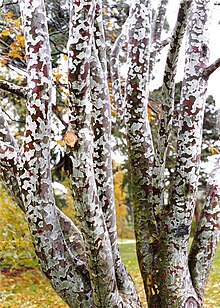
Pinus bungeana (English: Bunge's pine[2] or lacebark pine or white-barked pine; Chinese: 白皮松 Japanese: シロマツ, Korean: 백송; RR: baeksong) is a pine tree native to northeastern and central China.[3][4] It is a slow-growing tree that can grow to heights of 15–25m and is frost hardy down to below -26 °C. Its smooth, grey-green bark gradually sheds in round scales to reveal patches of pale yellow, which turn olive-brown, red and purple on exposure to light.




Distribution and habitat
Pinus bungeana is native to mountains of China, but is widely cultivated as an ornamental, especially for its attractive metallic bark.[1] It has naturalized in the Sierra de la Ventana of eastern Argentina.[citation needed]

Uses
It is grown as an ornamental tree in classical gardens seeking to imitate Chinese gardens where it symbolizes longevity. It can also be seen in botanic gardens and often grows with multiple stems.
