Pinus pumila, commonly known as the Siberian dwarf pine, dwarf Siberian pine,[1][3] dwarf stone pine,[1] Japanese stone pine,[3] or creeping pine,[4] is a tree in the family Pinaceae native to northeastern Asia and the Japanese isles. It shares the common name creeping pine with several other plants.



Description
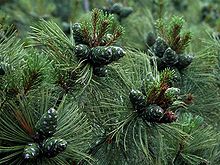
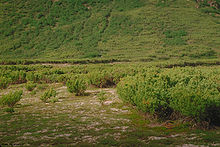
The Siberian dwarf pine is a coniferous evergreen shrub ranging from 1–3 metres (3–10 feet) in height, exceptionally up to 5 m (16 ft), but may have individual branches that extend farther along the ground in length. In the mountains of northern Japan, it sometimes hybridises with the related Japanese white pine (Pinus parviflora); these hybrids (Pinus × hakkodensis) are larger than P. pumila, reaching 8–10 m (26–33 ft) tall on occasion.
The leaves are needle-like, formed in bundles of five and are 4–6 centimetres long. The cones are 2.5–4.5 cm long, with large nut-like seeds (pine nuts).
Distribution
The range covers the Far East, Eastern Siberia, north-east of Mongolia, north-east of China, northern Japan and Korea.[3] Siberian dwarf pine can be found along mountain chains, above the tree line, where it forms dense, uninterrupted thickets; it also grows on the headlands above the Okhotsk and Bering Seas, Tatarsk and Pacific coast (the Kurils).
P. pumila grows very slowly. It can live up to 300 and, in some instances, 1,000 years.[5][full citation needed] In the colder conditions of Siberia, there are specimens which are 250 years old and older.
Ecology
The seeds are harvested and dispersed by the spotted nutcracker (Nucifraga caryocatactes).


Cultivation
This plant is grown as an ornamental shrub in parks and gardens. The cultivar P. pumila 'Glauca' has gained the Royal Horticultural Society's Award of Garden Merit.[6]